
How to decorate a newborn baby's room
At first, you picture a colour, a cot and perhaps a name on the wall. Then the baby arrives at three in the morning: can you enter without the ceiling light, reach a clean nappy with one hand and sit down without moving three cushions? The best nursery looks after the whole family.
To decorate a newborn nursery, first make the deliberately empty cot safe, arrange four zones — sleep, changing, adult chair and storage —, use three colours, provide three levels of light and keep a clear route. Then personalise a side wall with one strong image, well away from the sleep space.
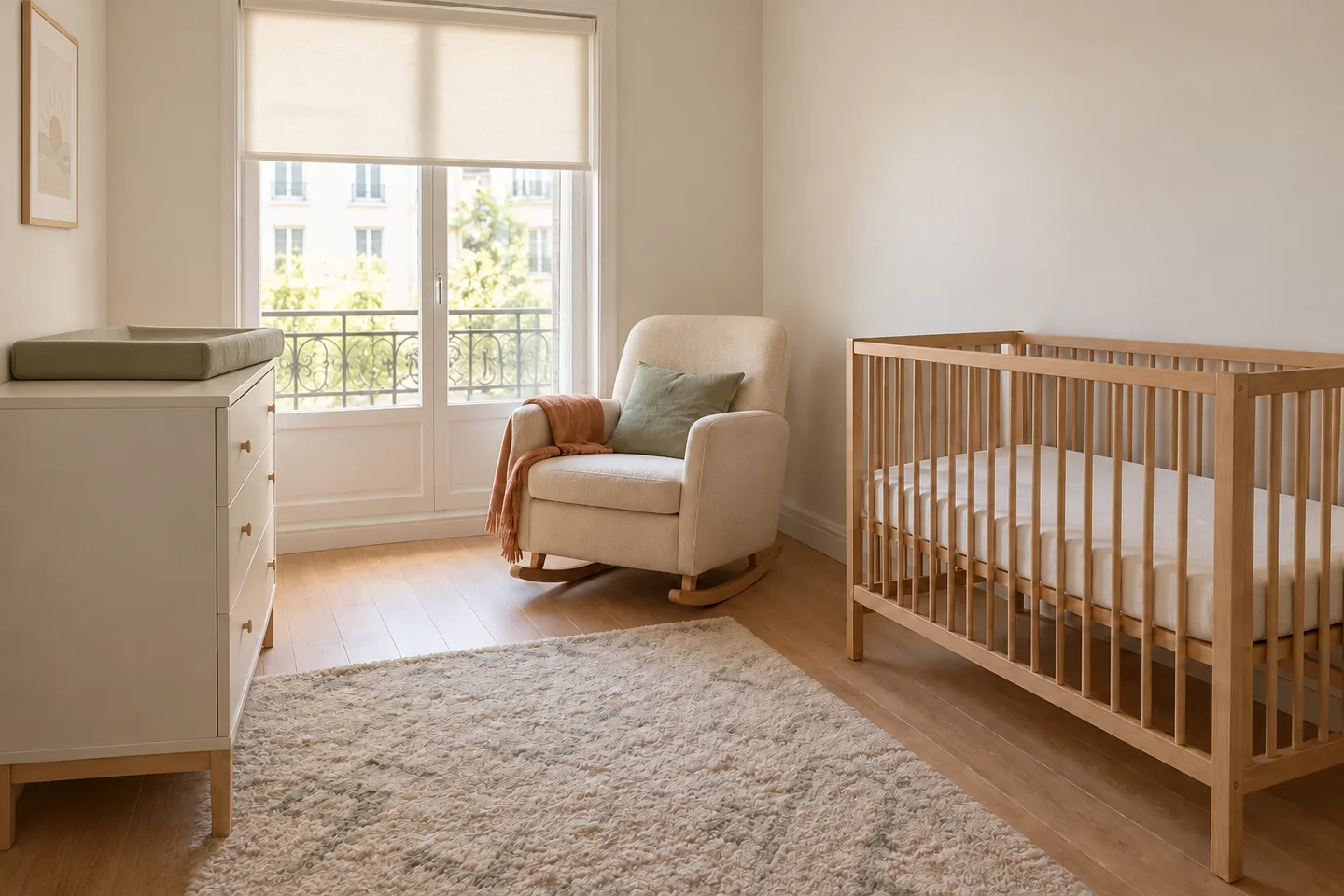
Start with the life that will happen in the room
A nursery is not a still photograph. It is a room crossed while half asleep, a place where somebody searches for a clean sleepsuit with a baby in their arms, rocks for longer than expected and puts down objects that were never in the design plan. Before choosing a theme, picture four actions: sleeping, feeding, changing and storing. If each one can happen without a detour, the decoration already has a sound structure.
Run a practical rehearsal. Walk from the door to the cot, then to the changing surface and the chair. The route should remain clear even when a laundry basket is waiting on the floor. Open every drawer, sit down and lower the lights. This simple scenario reveals more than a mood board: a handle that collides, a sliding rug or a lamp beyond reach becomes obvious at once.
Now choose three words for every later decision, such as calm, natural and bright, or warm, colourful and playful. Three words are more useful than a rigid theme because family books, gifts and inherited objects can enter the room without looking as though they landed in the wrong story.
- First: measure walls, openings and the real clearance around furniture.
- Next: place sleep, changing, feeding and laundry zones.
- Last: choose colours, pictures, a rug and the few details that make the room personal.
Prepare a nursery even if the baby first sleeps beside you
Health guidance recommends that a newborn sleeps in their own cot or bassinet in the parents’ room for at least the first six months. Preparing a separate nursery before birth is still worthwhile. It can hold clothes, changing supplies and quiet daytime feeds, and it will be ready when the move to a separate room feels right, without anyone building a wardrobe between night feeds.
This changes the way the room should be planned. The newborn may spend little time sleeping there at first, while the dresser, chair and storage will work from the day the family comes home. Treat the nursery as a gentle, useful base rather than a stage that only makes sense when the cot is occupied.
In a small home, make two connected micro-spaces: safe sleep beside the parents and changing plus clothing in the nursery. Repeat one colour, basket or small print in both places. Visual coherence does not require every function to be squeezed into the same room on the first night.
The cot is the one place decoration should leave alone
Decorate around the cot, never inside it. A newborn sleeps flat on their back in a suitable cot, on a firm, correctly fitted mattress with a secure fitted sheet, wearing an appropriately sized sleep bag. Pillows, quilts, blankets, bumpers, positioners, cushions, soft toys and extra mattresses stay outside the sleep space. A beautiful photograph cannot turn them into useful bedding.
Keep the cot away from windows, heaters, lamps, sockets, extension leads, curtains and blind cords. A hanging object that seems unreachable at birth may become a target as soon as the child can pull up. If you use a mobile, fix it securely, place it beyond reach and remove it when the child’s new abilities make its position unsuitable.
An empty cot does not make an empty-looking room. Let the wood form, wall colour, natural materials and a carefully placed print do the visual work. A securely fixed birth print on a side wall, outside the area above the cot and beyond its reach, personalises the space without placing loose objects where the baby sleeps.
- In the cot: a firm mattress, fitted sheet and baby in a correctly sized sleep bag.
- Around it: no reachable cords, curtains, heaters, lamps, loaded shelves or heavy frames overhead.
- In the room: fresh air, no tobacco smoke and a comfortable temperature following local health guidance.
Plan four zones instead of filling four walls
Give the quietest corner to sleep, away from direct heat and draughts. The changing zone needs a stable surface, supplies within one-handed reach and a closed bin. The adult zone may be one supportive chair with a stable side surface. Storage holds current clothes, future sizes and spare supplies. In a small room these zones can overlap, but their purpose should remain easy to read.
Keep a direct walkway from the door to the cot. At night, this empty strip of floor is more valuable than another piece of furniture. If you add a rug, place it decisively under furniture or fully within an open area so that its edge does not sit exactly where a tired foot lands. Check the door at every angle and use the space behind it only for occasional items.
Mark the footprint of furniture on the floor with masking tape before buying. Include the depth of open drawers and the room needed to pull back a chair. This rough full-scale plan prevents an unusable dresser and often shows that one wide, low, adaptable unit makes a room calmer than two tall pieces.
Choose colours that can live with everyday clutter
Clothes, books and toys will soon bring their own strong colours, so begin with one main tone, one supporting tone and one accent. Warm white, pale wood and sage; soft clay, brown and muted pink; or blue-grey, cream and straw yellow all create rhythm without trapping the room in a short-lived trend.
Dark colours can work beautifully on the cot wall or in an alcove. Deep blue, forest green or terracotta can make a room feel held rather than small when the remaining surfaces stay light. View a large paint sample in morning, afternoon and lamplight; a tiny card rarely shows how a colour will behave across an entire wall.
Finish painting early enough to air the room thoroughly, follow the product instructions and space out new purchases. Fresh paint, newly unpacked furniture, a mattress and textiles can all introduce an odour. Assembly, washing and ventilation done gradually make the first homecoming far more pleasant.
Build separate lighting for day, evening and 3 a.m.
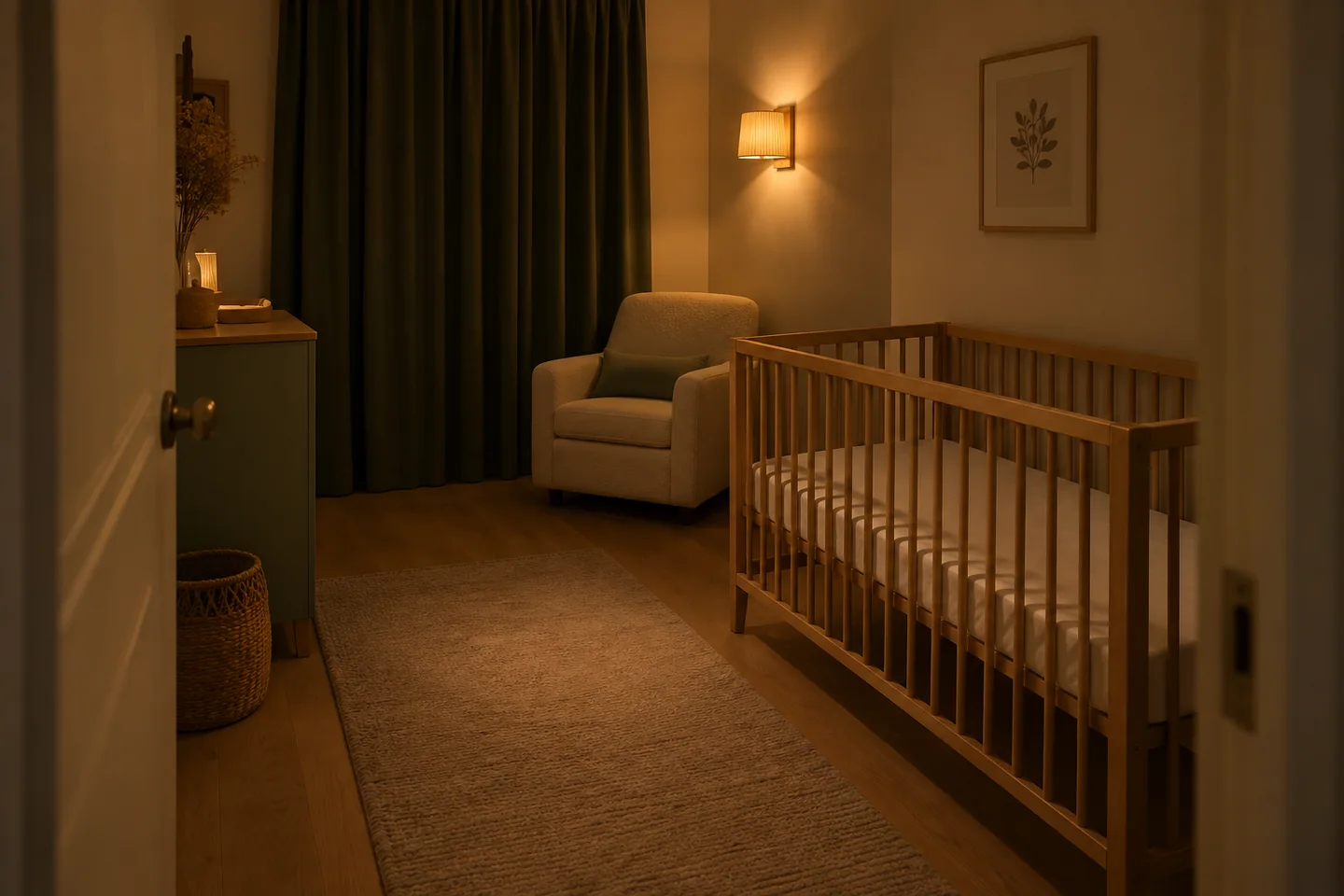
A central ceiling lamp can illuminate a room, but it cannot adapt to every moment. Use three levels: daylight, a general light for cleaning and putting clothes away, and a low indirect source for night waking. The last one should switch on before you fully enter or sit within easy reach of the chair, with no cable accessible from the cot.
At night, warm low-intensity light is enough to see a zip without waking the whole household. Aim it at a wall or the floor rather than the baby’s face. During the day, admit natural light; at bedtime, suitable curtains or blinds create darkness, with every cord kept securely out of reach.
Put your eyes at mattress height and look towards each bulb. A source hidden from a standing adult may shine directly at a lying baby. Repeat the check from the chair: there should be enough light to see comfortably without flooding the entire room. This modest adjustment will shape more nights than decorative fairy lights.
Set up changing so one hand can stay with the baby
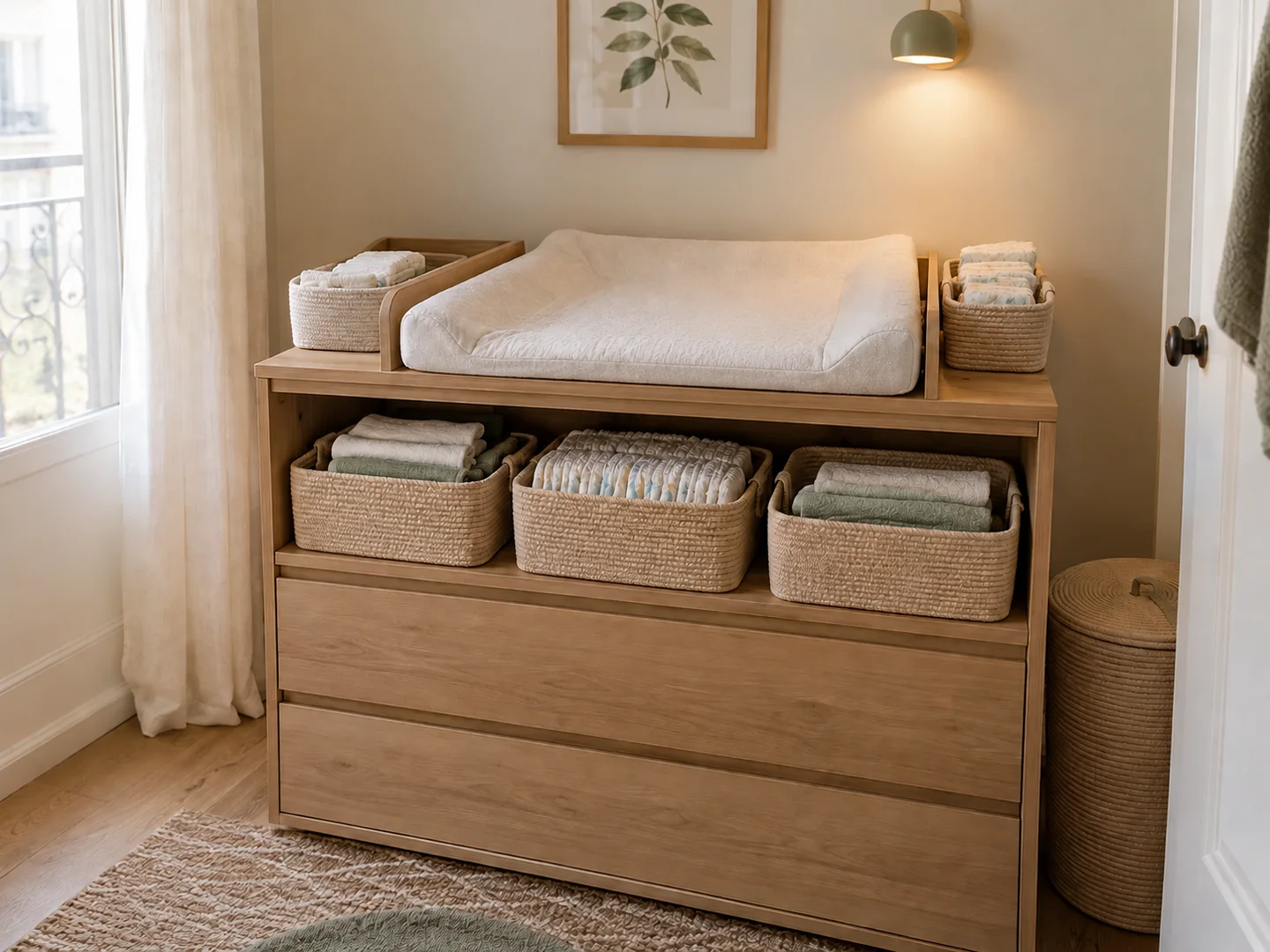
Test a changing station by keeping one hand in the middle of the mat while reaching for everything else with the other. Nappies, cloths, a clean outfit and laundry should all be available without turning away. A baby is never left alone on the surface, even briefly; good organisation removes the temptation to take one small step towards the wardrobe.
A stable dresser with a securely fitted changing top keeps working long after nappies disappear. Put daily supplies in the top drawer, current clothes below and future sizes further down. Open baskets are useful for ordinary textiles, while medicine, care products, small items and plastic bags belong in closed storage out of reach.
Anchor the dresser to a suitable wall fixing even if it feels heavy. A newborn cannot pull out a drawer, but a toddler will use one as a step. Designing for the child the baby will become prevents an urgent safety retrofit later.
- Top drawer: complete changes, muslins and two spare outfits.
- At floor level: stable closed containers for laundry and waste.
- Out of reach: medicines, care products, small objects and bags.
- At the back: a proper wall anchor suited to both the furniture and wall.
Ask fewer pieces of furniture to do more
The useful core is often a cot, dresser and comfortable seat. A wardrobe is worthwhile when the room has no cupboard; otherwise it occupies a great deal of space to hang tiny garments that store well folded. A broad dresser can hold changing supplies now, clothes next, then toys and school materials years later.
Try the chair properly. Feet should reach the floor, the back should feel supported and armrests should not lift the shoulders. A photogenic seat that hurts after twenty minutes will become a clothes rack. Add a small stable surface for water rather than a light table that tips at the first movement.
Second-hand furniture can be excellent for a dresser, chair or shelves after careful stability and condition checks. For any sleep product, verify the instructions, fittings, compliance and history, and use a clean, firm, undamaged mattress that fits correctly. Convenience should never be the only test.
Add softness with materials that can be washed
Wood, washed cotton, carefully placed wool and woven fibres warm a neutral palette without demanding ten decorative objects. Vary texture more than pattern: a matte curtain, low-pile rug, basket, tactile chair and timber frame create enough depth for the room to feel rich while remaining calm.
Ask how a textile is cleaned before asking whether it is beautiful. Removable covers, washable curtains and a rug that is easy to vacuum survive early childhood better. Keep cushions and throws on the adult chair, and remove them if there is any risk of an adult falling asleep there with the baby. Soft furnishings never migrate into the cot.
Curtains, a rug and a shelf of books soften echo without making the room difficult to clean. Babies do not need absolute silence, and the nursery does not need upholstered walls. The right balance quietens hard surfaces while avoiding a collection of dust traps.
Personalise the room without writing the name everywhere
One focal point tells the story better than six matching accessories. Choose a birth print with the name and details, a framed first photograph, a small piece made by a relative or a favourite illustrated book. Leave clear wall around it. That breathing space gives the object presence and leaves room for the story to grow.
A birth print belongs to the interior without looking like short-lived nursery equipment. It can preserve the date, time, weight and length after those figures begin to blur, and stay when the cot has gone. Select its size for the wall rather than the phone screen: a tiny frame disappears above a broad dresser, while a vertical format naturally balances low furniture.
Avoid repeating one motif across bedding, baskets, wallpaper and every picture. Rooms become memorable when they accept slight irregularity: a gifted toy, a parent’s worn childhood book, an unexpected photograph. Prepare the framework, then let family life finish the decorating.
Make a small nursery feel generous
In a small room, visible floor is the first luxury. Choose furniture raised on legs, continue one colour across a wall and storage, and use height only for securely fixed items that remain out of reach. An unbreakable, correctly attached mirror can return light, but it need not face the cot or cover an entire wall.
Store future sizes in labelled boxes high in the cupboard and keep only the current size within the room. As one crate of outgrown clothes leaves, the next comes in. This rotation stops gifts and multipacks from taking over. Under the cot, use only closed containers that do not obstruct ventilation or cleaning.
Wall decoration creates more impact than objects spread across the floor. A painted band, two aligned frames or wallpaper on one wall gives a clear idea without narrowing the route. Every object that has no function should clearly earn the space it occupies.
Spend by priority and leave room for what you learn
Budget first for the things that support, light and store. Paint and details follow. A coherent room does not require a matching furniture range: similar woods, three repeated colours and simple forms can connect pieces from different places. Shared handles or timber frames may be all that unifies them.
Hold part of the budget until after birth. Before living the routine, nobody knows whether a second drawer unit, better blackout curtain or different chair will matter most. A room filled to eighty per cent leaves space for real needs and avoids charming purchases that become obstacles in the first week.
When choices are difficult, prioritise the correctly fitted mattress, stable furniture, comfortable chair and night lighting. Save on themes, coordinated collections and short-lived accessories. Safety and comfort are felt many times each day; the exact shade of a basket is mostly noticed in photographs.
A simple timeline before and after birth
Two months before the due date, finish dusty or strong-smelling work, assemble and anchor furniture, and ventilate. One month before, wash textiles, prepare the sleep space and organise the first clothing sizes. In the last week, stop embellishing: test the night route, assemble a few complete changes and protect the remaining empty space.
After coming home, observe for seven days before ordering anything else. Note what forces you across the room, what is missing from one-handed reach and what has never been used. Move a basket, adjust a lamp or remove a table. A successful nursery is tuned like any lived-in home, through small corrections rather than a second decorating campaign.
Three months later, inspect the room again from the child’s level. Hands will soon grasp, pull and support body weight. Raise small objects, check every fixing and prepare for drawers to be opened. Birth does not finish the design project; it is when the room stops being an image and begins to grow.
- Before buying: measure, draw the zones and choose three mood words.
- Before assembly: paint, ventilate, read instructions and prepare wall fixings.
- Before homecoming: wash, organise, test lights and clear the route.
- After one week: move objects according to the actions that actually repeat.
- Every three months: reassess the room as the child gains new abilities.
Frequently asked questions
When should you start preparing a baby's room?
Finish painting and furniture assembly about two months before the due date so the room can air and the work stays unhurried. Wash textiles and arrange the first sizes a month before. Use the final weeks to test routes and lighting rather than starting disruptive work.
Which colours work best in a newborn nursery?
Choose one main colour, one supporting colour and one accent, then test them at several times of day. Pale tones are optional: a deep colour can work beautifully on one wall when the rest of the room stays bright and natural textures add warmth.
What can be put in a cot as decoration?
Nothing decorative belongs in the sleep space. Use a firm fitted mattress, a secure fitted sheet and place the baby on their back in a correctly sized sleep bag. Keep pillows, quilts, blankets, bumpers, toys and positioners outside, and decorate the surrounding wall instead.
Where should the cot go in the room?
Choose a quiet area away from windows, heaters, curtains and cords, sockets, extension leads and reachable lamps. Keep a direct route from the door, and make sure no heavy or insecurely fixed object hangs above the sleeping area.
How do you arrange a very small nursery?
Protect the clear floor and route first. A cot, dresser that doubles as a changing station and supportive chair are often enough. Use walls for decoration, secure high storage for reserves and keep only the clothing size currently being worn in the room.
How much should you spend on nursery decoration?
There is no required figure. Put most of the budget into suitable sleep equipment, stable furniture, a comfortable chair and practical night lighting. Paint, second-hand pieces and a few pictures can create the atmosphere, while a reserve covers needs discovered after birth.