
The night they were born
There is always someone who wasn’t there. And the first thing you ask, when you weren’t, is: when? At night? Nobody can quite answer. That night, nobody was looking out of a window.
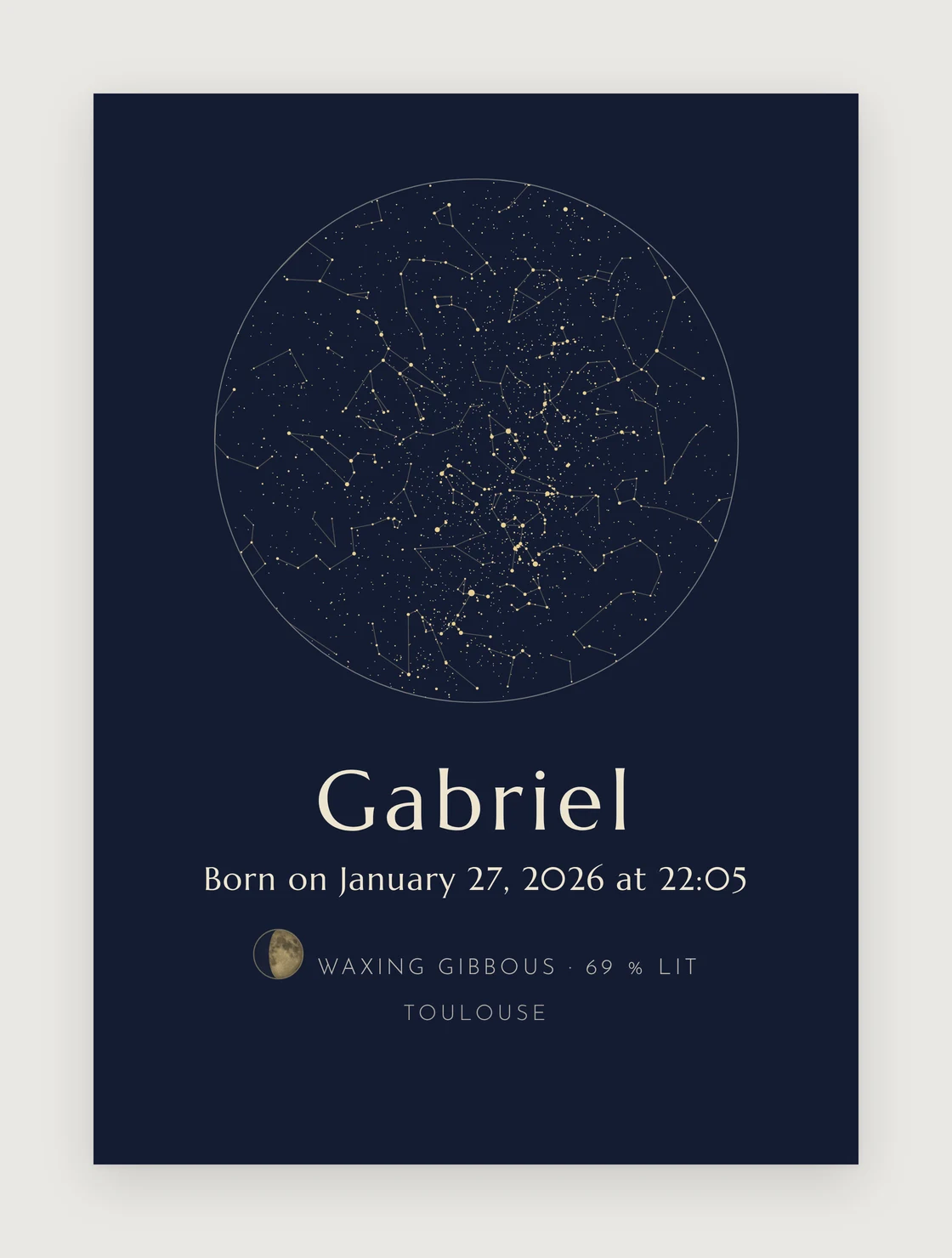
What you ask when you weren’t there
The grandmother rings at seven in the morning. She got the message at 6.12, she hasn’t slept since, and she asks the same questions in the same order: how is the mother, how much did the baby weigh, and what time exactly. Not the weight first. The time. Because the time is the one thing that lets her place herself — at that moment, she was asleep.
That is how people hold on to something they didn’t witness. You run the film backwards from your own kitchen, four hundred miles away, and you look for where you were. Something is always missing: the setting. The room, the corridor, the window. Whatever was overhead.
Nobody looks at the sky that night
There is no window worth looking at in a delivery room. There is a clock, there are voices, and there is a tiredness nobody describes afterwards. The father goes down to an empty car park at four in the morning to ring his own mother, and he is the only person with the sky in front of him — without seeing it, because he is thinking about something else entirely.
It was there all the same. The stars above that hospital, at that exact hour, were not the ones from an hour earlier, nor the ones thirty miles away. The moon stood at a precise illumination, and it can be found again. It is an odd thing to take in: the only picture missing from that night is the only one that can still be rebuilt.
What this print is actually saying
You might take it for a decorative idea — a midnight-blue field with white dots scattered about. It is not one. The disc that gets printed is the sky that stood over the place you give, at the hour you give, with the constellations where they were and the moon in the phase it held. Shift the hour by a night and the drawing changes.
That is what makes the object hold. A ten-year-old who works out that the map above the bed is true — that those stars really were overhead — never looks at it the same way again. And whoever gave it has answered, without saying so, the question they had been carrying since the first phone call: what was that night like.
The three things to ask for
The town, the day, the hour. They come without any need to interrogate anyone, because they are exactly the three the parents have repeated fifty times on the phone. The hour in particular is not optional here: without it there is no sky to work out, only a starry background, and that is not what anyone is buying.
The rest follows on its own. The time zone of the place is worked out along the way, summer time included, and the moon is the moon of that night rather than a crescent chosen because it looks nice. Allow about a week to the letterbox in France and ten days elsewhere in Europe: enough to arrive once the house has gone quiet and a gift can actually be looked at.
Frequently asked questions
Do I really need the exact time of birth?
For this print, yes. The sky turns: an hour out and they are no longer the same constellations overhead, and a map worked out on an invented hour is a pretty drawing that tells you nothing. The parents will give it to the minute — they have said it aloud all day. If you truly can’t get it, another design will suit you better.
What if the baby was born in broad daylight?
It changes nothing in the working out. The stars are above us at noon exactly as they are at midnight; it is only the sun that stops us seeing them. The print shows the ones that genuinely stood over that place at that hour, without worrying about what could have been made out from the car park.
Can it be given years after the birth?
Yes, and it makes a fine birthday present for exactly that reason: it arrives when the child is old enough to understand what they are looking at. The calculation reaches back as far as you like — a night from thirty years ago is drawn as precisely as one from last week.
Do I need the exact address of the hospital?
No, the name of the town is plenty. On the scale of a sky, a few miles move nothing you could see; what counts is the part of the world and the hour. Type the town and the editor handles the rest, time zone and summer time included.