
What to say to people who have just had a baby
The message has been open for twenty minutes. “Congratulations” has already gone round the group chat three times. And you would like to write something that doesn’t read like everyone else’s.
The problem isn’t finding the words
It is knowing who you are talking to. An announcement arrives and you answer the couple — when at that precise moment there is no couple. There are two exhausted people going through two different things. The mother gave birth thirty hours ago. The father hasn’t slept either, and nobody is asking him how he is.
That is why “congratulations” lands flat. It isn’t a wrong word, it is a ceremonial one, and there is no ceremony: there is a room, a hospital tray, and somebody crying for the third time that day without quite knowing why.
What reaches people, nearly always
Name the child. Write the name straight away, in full, without wrapping it in anything. The parents have spent months keeping it to themselves; seeing it in somebody else’s handwriting, for the first time, does something they weren’t braced for. “Welcome, Jeanne” beats three lines of well-turned wishes.
Then say you are thinking of the mother. Not “congratulations to mum” — say you are thinking of her, of her alone, and that you know it was long. And say what you are going to do, precisely: I’m coming on Sunday with food, I’ll ring in a fortnight, I’m staying away for now but I’m here. A dated intention is worth ten times more than “let me know if you need anything”.
What is better kept to yourself
Advice, first of all. Nobody asked. Comparisons with your own labour, your own nights, your own child who slept through at three weeks. And questions that need answering: a message that has to be replied to is one more chore in a day with no room left in it.
Write the way you would leave something on a table — without waiting for it to be picked up. Parents read everything, often days later, often at four in the morning during a feed. It is the messages that ask for nothing that get read twice, and there are always two or three that get kept.
The line that stays
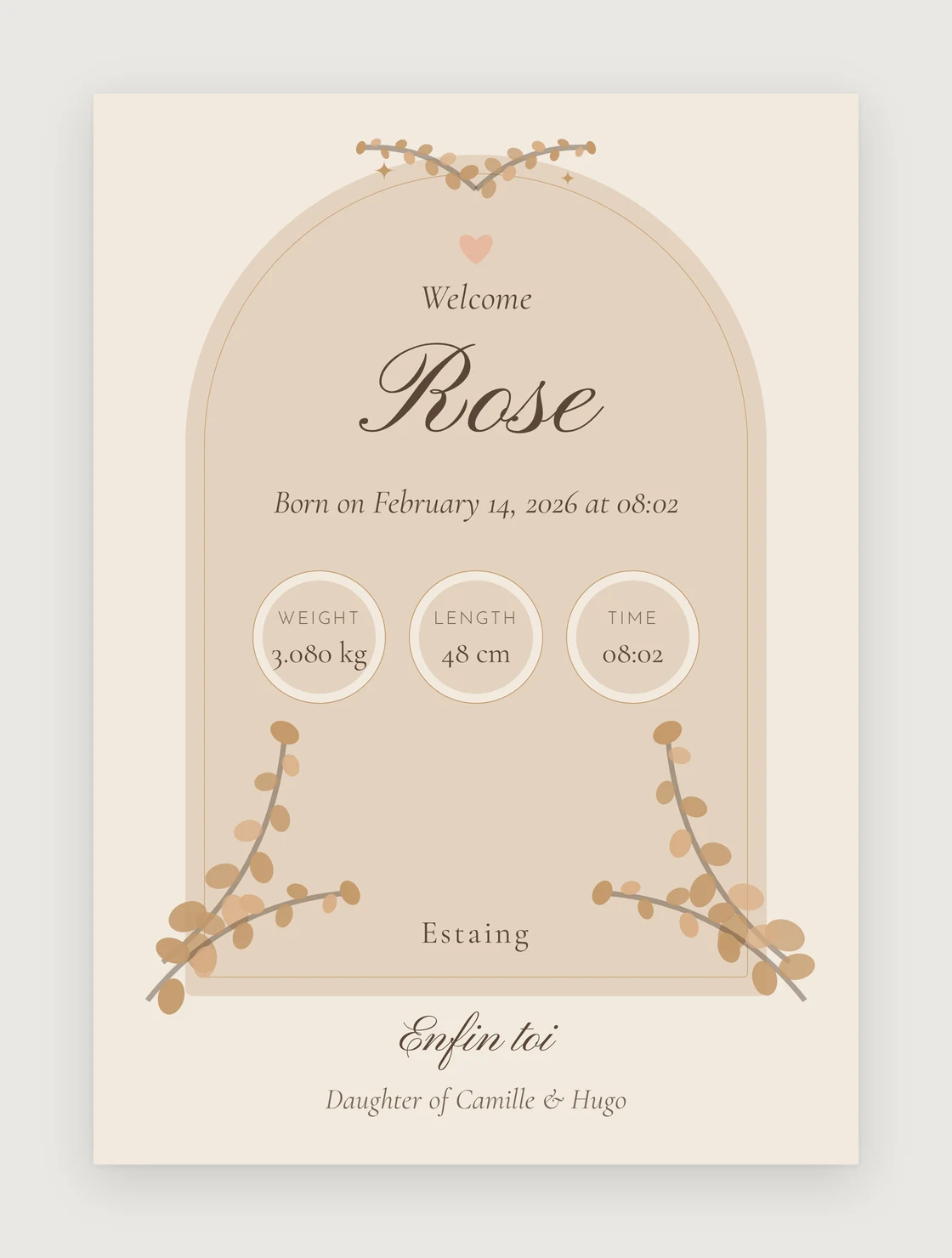
A message is read once. There is one place, though, where a line outlives the year: whatever ends up on the wall. Our birth prints carry one line, a single one, right at the bottom. Room for a short sentence, and that is exactly the right length — the length an eye rereads without meaning to, walking past.
A few that fit on that line, to start you off: “At last, you.” “You were waited for.” “The best morning of our lives.” Nothing remarkable, and that is precisely why nobody tires of them. It is often where the sentence you spent twenty minutes hunting for ends up.
Frequently asked questions
What do you write when you don’t know the parents well?
Keep it short and don’t try to sound close. The child’s name, one honest sentence, and no questions. “Welcome to Jeanne. Thinking of the three of you.” That is enough, and it reads far better than a long message from someone they barely know. Length is not proof of affection; more often it is awkwardness in disguise.
Should you congratulate the father too?
You should talk to him, which is not the same thing. Everyone congratulates him and almost nobody asks how he is. One line addressed straight to him, without going through “dad”, lands harder than you would expect — usually because it is the only one of its kind that day.
When should the message go?
Straight away for the first one, and keep it short. Then a second time three or four weeks later, when the visits stop dead and the house goes very quiet. That is the moment the messages have dried up and a new one does the most good. Almost nobody thinks of it, and it is the one parents remember.
And if the birth went badly?
Then don’t congratulate, and don’t pretend. Say that you know, that you are thinking of them, and that you want nothing back. “I know it was hard. I’m here, and there’s nothing to answer.” What hurts in those weeks is never clumsiness — it is the cheerfulness of people who hadn’t heard.