
What you forget about a birth in five years
There is always someone who wasn’t there. And often it is that person who remembers best five years on: they wrote the hour on the corner of something as they hung up, because it was all they had.
Memory doesn’t keep what you expect
Ask a parent, five years on, how much their child weighed. Half the time they will hesitate, glance at their partner, and settle on “seven pound something, I think”. Ask them the time: they will give it to the minute, without pausing. The weight was written down everywhere. The hour was written down nowhere.
That is because the hour was spoken. Repeated thirty times in a day, on every call, in every message. The weight was read once off a form and never said out loud. Memory keeps whatever went through the voice and drops the rest, without warning and without letting anyone choose.
What goes first
The room: the number, the floor, the colour of the corridor. The midwife’s name, which everyone swore they would never forget. What was eaten, whether it was cold, who was waiting outside. All of it holds for a few months, then dissolves, and what is left are islands nobody can date any more.
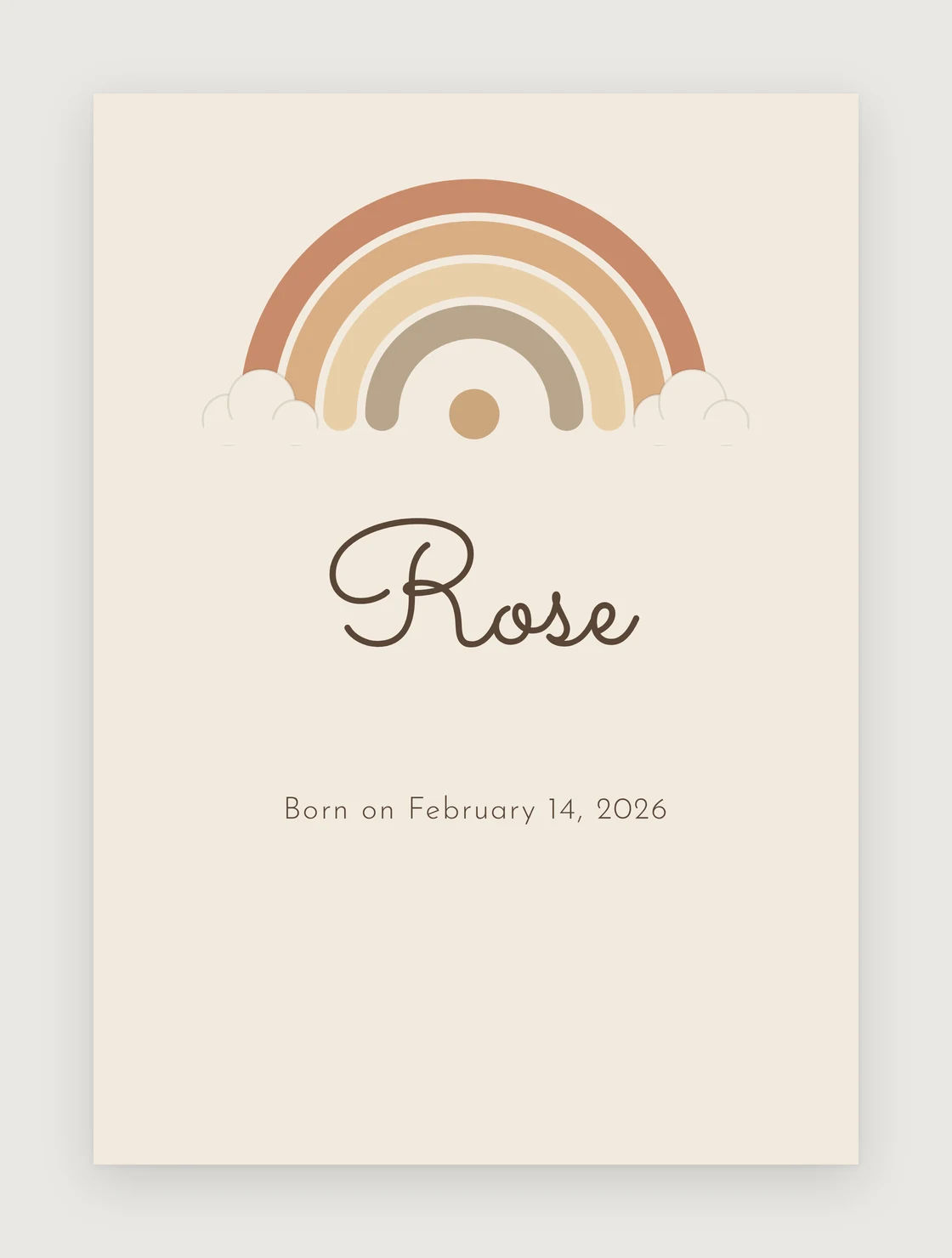
Three things stay, and they are always the same three: a name, a day, and a sentence. A sentence somebody said walking into the room, or wrote in a message at six in the morning. They are exactly the three that go on a birth print. That is not a coincidence — it is what survives.
The photographs save nothing
People assume the two hundred pictures from the first days settle the question. They don’t. They pile up in a phone that will be replaced, in a cloud whose password will change, in a chat somebody will clear out one day to make room. Five years on, finding them takes half an hour and a login nobody has any more.
What you find without looking is what is on the wall. A printed thing asks for no account and no battery: it is simply there, in the hallway, and you walk past it eight times a day without seeing it. Until the day the child stops, reads it, and asks their first question about it.
Write it down while you still know
That is the only urgent thing in this story, and it has nothing to do with selling anything: the details leave quickly. The exact hour, the town, the sentence somebody said on the way in. In six months you will have an approximate memory of it; in five years, a reconstructed version that sounds true and isn’t quite.
Write them somewhere, even on the corner of an envelope — which is what the person who wasn’t there does without thinking, scribbling the hour as they hang up. And if you are going to turn it into an object, do it while the numbers are fresh. A print takes ten minutes to put together and arrives within a week in France, ten days elsewhere in Europe: enough to fix something memory is already letting go of.
Frequently asked questions
What goes first after a birth?
The weight and the length, nearly always, because they were read off a form and never said out loud. Then the setting: the floor, the room, the midwife’s name. The hour, on the other hand, lasts decades — it was spoken thirty times in a day, and that is what fixes it.
Is it better to put everything on the print, or keep it simple?
Put on what you want to find again in twenty years, not what the form happens to offer. For most people that comes down to a name, a date and a sentence. Weight and length are a bonus that gains value later, on the day the child cannot believe they once fitted inside those numbers.
Is it too late to order one years afterwards?
Not at all, and for some designs it is the better moment: a five-year-old understands what they are looking at, which a newborn plainly does not. The only risk in waiting is that the details have already blurred — check the hour with somebody before committing the one you think you remember.
How do you find the exact hour years later?
Three places, in this order: the red book or health record, where it is written at birth; the birth certificate, which the registry will issue again; and the messages sent that day, which nearly always carry the time of the first call. The third usually answers it in under a minute.