
The night you met, and nobody wrote down the time
Three years on, nobody can say what time it began. There's a place, two versions of the date, and a night you mostly remember for the cold. Here is how to give that night back, using what you really have left.
For the anniversary of the night you met, give what you actually remember: the place, engraved as GPS coordinates on a cherry wood bracelet; the night, as the exact sky (or the moon) of that evening; just the date, as the planets in their place that day; or the whole story, in three to eight moments. At Marcel et les Blondes everything is made to order in France: allow a week before the date, ten days for delivery outside France.

The question that silences the table
Third anniversary, a dinner that runs long, and somebody finally asks: when was it again, the night we met? Two dates arrive at once. They aren't even in the same month.
Then comes the nastier question: and what time? Silence. One of you remembers the rain, the other the green coat, nobody the clock. Yet in every couple there is someone who can recall everything else in a flash — the too-loud bar, the daft line, the way you both pretended to leave. That someone is the one buying the gift, and this is where it gets stuck: you can only give what you managed to keep.
What a couple keeps, and what slips away
A meeting is really three things, and they fade at different speeds. The place lasts: you walk past it again, you can point at it. The day wears down faster — every couple holds two versions, and one of them is wrong. The time almost never survives, because nobody checks a watch when something is starting.
The right gift starts from what is left, not from what is missing. If you remember the place, give the place. If you hold the date, give the date. And if you can recover all three, you can give the sky of that evening, which is a different gift altogether.
Finding the time when nobody wrote it down
It turns up more often than you'd think, because a phone often keeps what memory loses. There are four places to look, in this order:
- The first photo of the two of you, in its original version: its metadata gives the date, the time and often the place — a copy received through a messaging app usually loses them.
- The first message you exchanged: it carries its own timestamp, a good clue if you wrote to each other that same evening.
- A booking or a payment: a reservation, a ticket or a card payment notification gives a nearby time (the table, the train, the payment), to adjust with what you remember.
- A witness: the friend who introduced you may remember the bar, the evening, sometimes when you left.
If it's the place that stayed
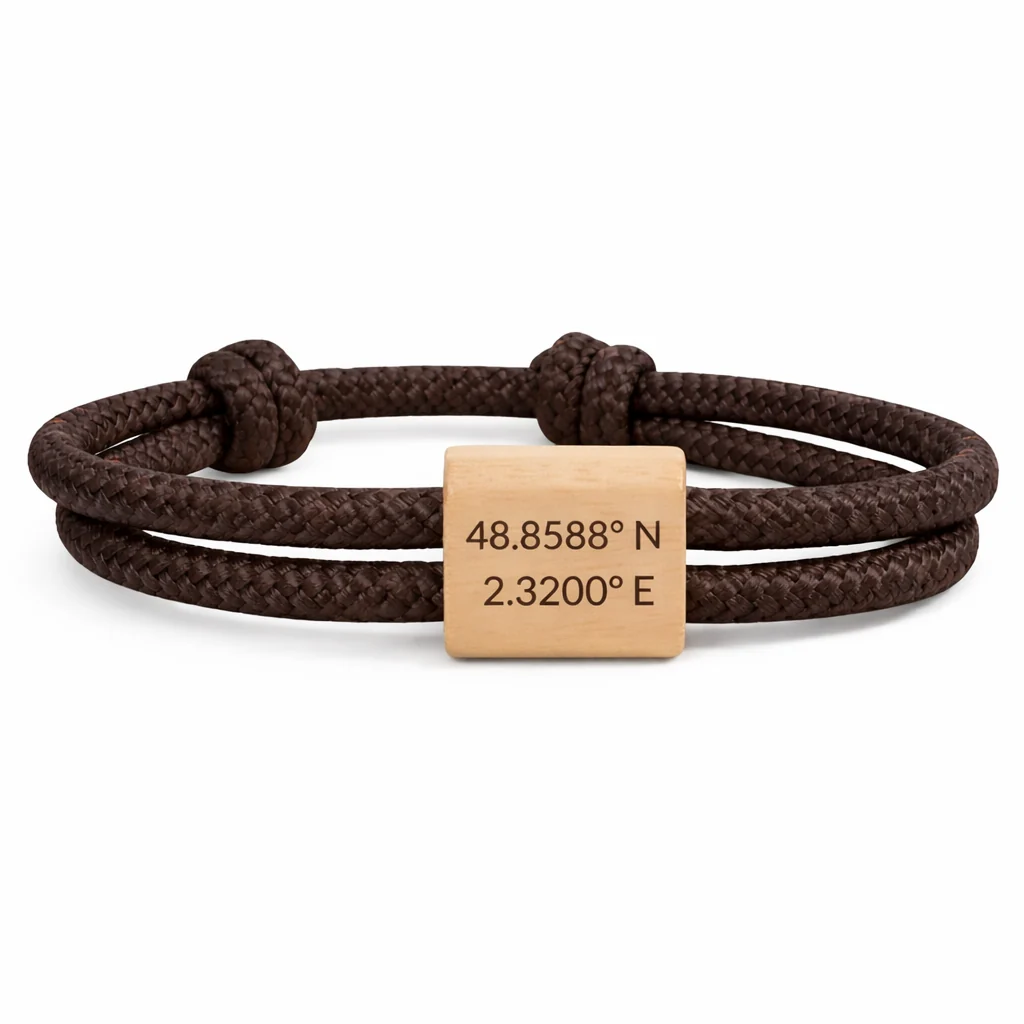
The bench outside the station, the terrace of the bar that has since closed, the platform where you said goodbye without saying it. A place holds better than a date because you go back to it, and that is exactly why it deserves to be engraved: two lines of numbers, latitude and longitude, that mean nothing to anyone who doesn't know the spot.
You type the address of the bar, the street or the station, written as on an envelope and not just its name; the coordinates are worked out for you, and you check them before ordering. They are engraved on a cherry wood bead that slides on a marine cord. For someone who never wears a bracelet, it's one that doesn't look like jewellery. The bar may have changed its name; the spot hasn't moved.
If it's the night that stayed
A night is recognised differently from a place: by the cold, the light, what you were looking at when you weren't yet looking at each other. And then the sky: the one that was above your head, the stars a naked eye could see under a clear, dark sky, positioned as they were for that place, that day and that hour.
The hour matters: the sky turns fifteen degrees every hour. Twenty minutes off moves it by five degrees, not enough to change what you recognise; two hours off moves it by thirty. You can set your photo from that evening in a circle under the stars, or leave the sky alone with a title underneath. And if it was the moon you were looking at, another poster keeps the moon of that night, with its phase, in the middle of its lunar month; it asks for the same three things: the day, the hour and the place.

If all you know is the day
It's the most common case, and nobody dares say it: you know the date, you've lost the time, the place is hazy — or you met online, which makes the question of place almost absurd. If nothing comes back, don't invent it: a wrong time, once printed, can't be fixed. Better a gift that asks for no more than you've got.
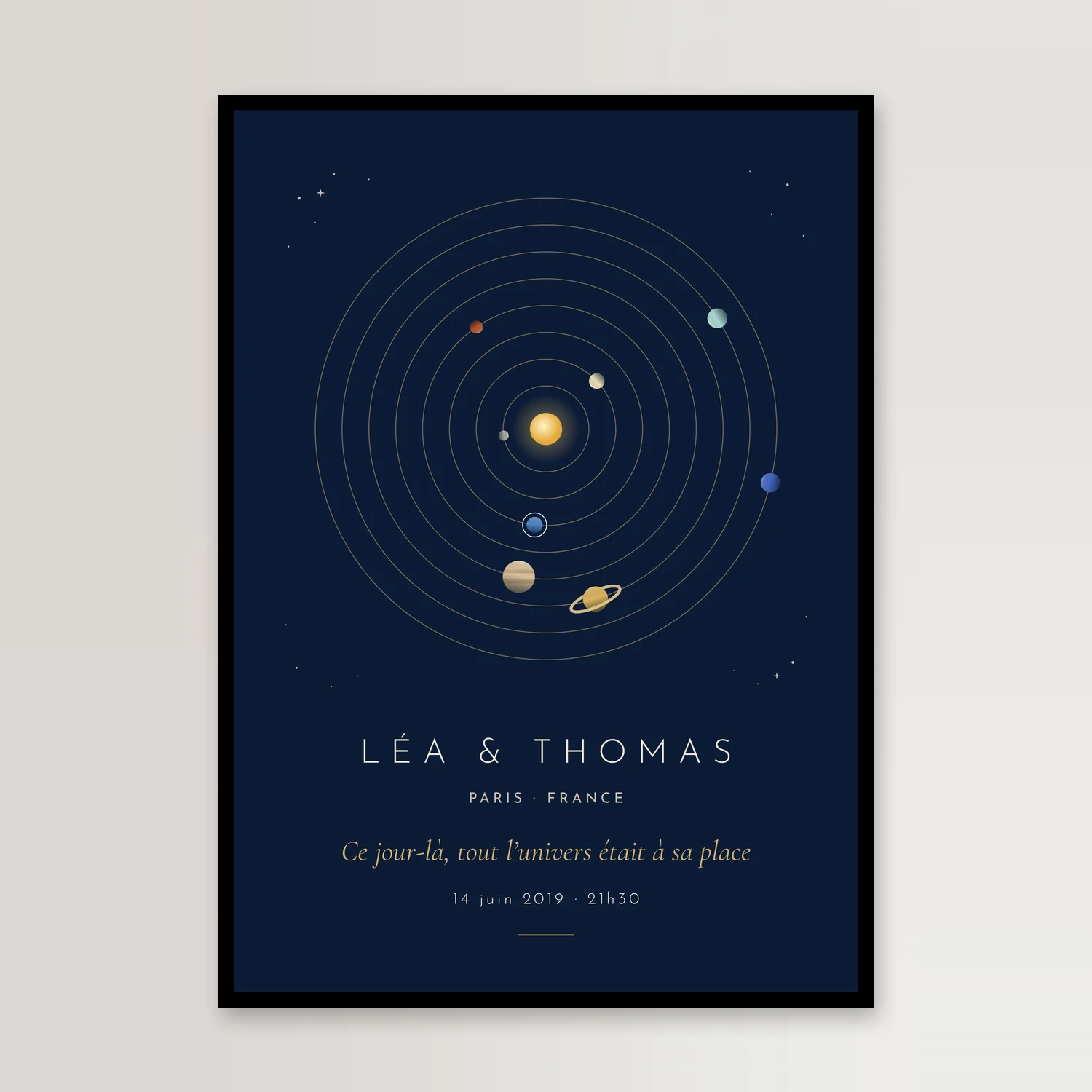
The solar system is one: eight planets around the Sun, each in its real position on the day you met, calculated rather than drawn at random. The day is enough. The time is added if you have it, and the place doesn't matter — seen from the Sun, Dublin and Lisbon are in the same spot. To everyone else, a pretty diagram; to the two of you, the sky of the first day.
If you want to tell all of it
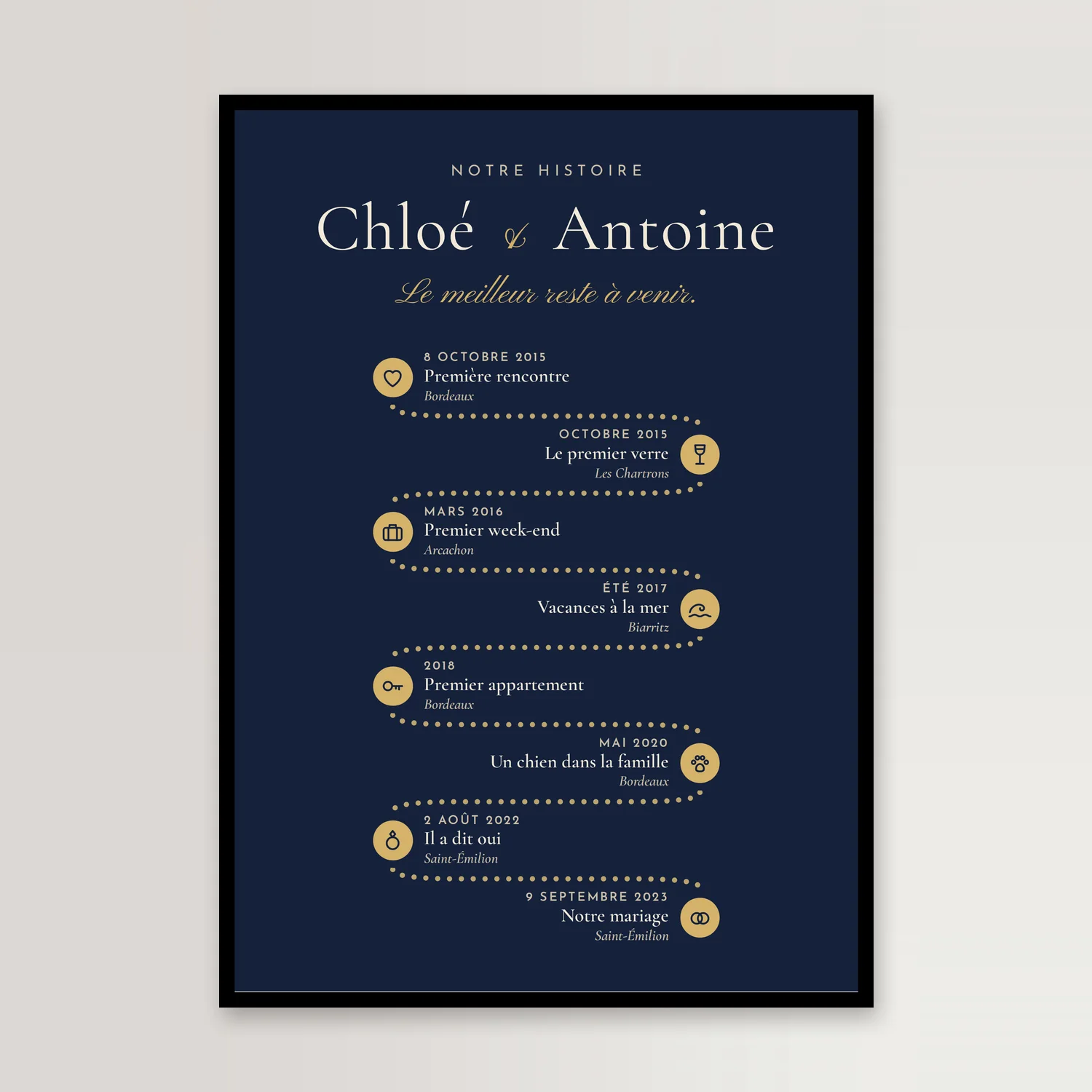
An anniversary of meeting doesn't always mean looking back to that first evening. Sometimes you just want to show the road: the meeting at the top, then the first trip, the flat, the dog, the yes. Three to eight moments on one poster, each with, if you like, its date, its place and its little drawing, in the order they arrived.
You can fill it in line by line, even on a phone, and it has one advantage: it asks for nothing exact. “The summer we met” is a perfectly good date for something nobody can place any more.
Which one to give, depending on what you have left
Ask yourself instead: what do I really know about that night, and how sure am I of it? Depending on your answer, here is what to give:
- You have the day, the time and the place: the sky of that night, or its moon, with or without your photo.
- You have the place: the GPS coordinates, engraved on a bracelet.
- You only have the date: the planets of that day.
- You want to tell what came next: your story in moments, three to eight.
How long before the date
Everything is made to order: allow a week before the date for delivery in France, ten days for delivery outside France. If you're running late, the printable file arrives by a download link, without waiting for a parcel.
Frequently asked questions
How do you find the exact time you met?
Start with the first photo of the two of you, in its original version: its metadata gives the date and the time, often the place. Otherwise the first message in your conversation is timestamped, and a booking, ticket or card payment notification gives a nearby time, to adjust with what you remember. If nothing comes back, choose a poster that doesn’t need one, such as the planets of that day or your story in moments.
Is the sky on the poster really the sky of that night?
Yes. The stars are calculated for the place, the day and the hour you give: they are the ones a naked eye could see under a clear, dark sky, positioned as they were above you. It isn’t a decoration: shift the time by two hours and the sky changes.
We met online: which date and which place should we choose?
For the date, the first message; for the place, where you first met in person. The planets of the day need neither, and another poster draws the shortest line between your two cities if you spent a long time apart.
What should you give after ten years together?
The older the date, the better the place holds up against the time: the engraved coordinates of the spot, or your story in moments, which tells ten years rather than one evening. The sky of that night keeps all its meaning, as long as you have found the time.
Do you need the exact spot for the star map?
No, the town is enough: within a few kilometres the sky is the same, while it clearly changes from one region to another. Better the right town than a street you’re not sure of.
How long before the anniversary should you order?
Order a week before the date for delivery in France, ten days for delivery outside France: everything is engraved or printed to order. If you’re late, the printable file arrives by a download link, without waiting for the parcel.