
Which moon was shining that night? The poster to give for a date that matters
On Christmas Eve someone tells, for the tenth time, how they met, and nobody remembers the moon. It was there all the same, in one precise shape. Here is how to find it, what the poster shows, and how long you have to order so it arrives before Christmas.
A day’s moon phase comes from the date, an approximate time and the city. The personalised moon-phase poster shows that night’s moon with its phase and the share lit, ringed by every night of the lunation, and you see it before ordering. For Christmas, order by 18 December in France and 15 December in other EU countries, Ireland included; after that, use the printable file.
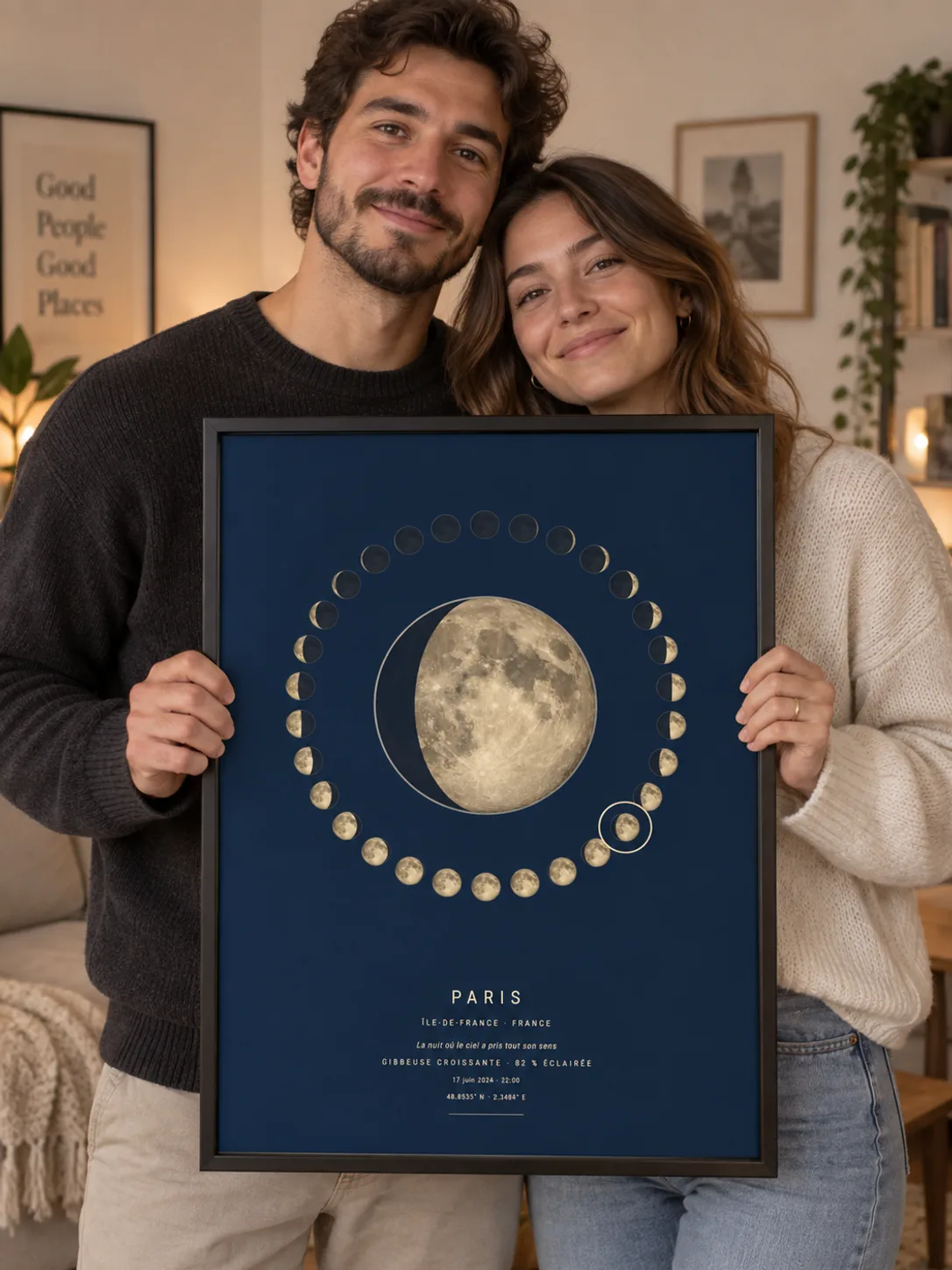
Who remembers the moon on their first evening together?
On Christmas Eve, somewhere between the last mince pie and the coffee, the story of how they met comes round again. She remembers the dress, he remembers the song playing in the bar, and each corrects the other on the time. Nobody mentions the sky. There was a moon that night all the same, full, half, or just a thin line, and nobody looked at it. We never remember the biggest thing in the room.
When you’re shopping for someone who already has everything, that’s exactly what’s missing: something you can’t buy anywhere, because its raw material is a date, theirs. The moon of that date can be found rather than guessed, and the same phase almost never falls on the same day two years running.
What was the moon phase on a given day?
It is worked out from the date, an approximate time and the city, and it reads as two things: the name of the phase and the share of the disc that is lit. On the poster you see it before ordering: the moon redraws itself as you type, and what you’re looking at is the print itself. No ephemeris table to dig through.
The calculation is the astronomers’ own, checked against published ephemerides, and it works for a past date as well as a future one: a wedding can be given before the day. The table below lists the eight phases, from one new moon to the next, with when you can see each.
| Phase | Days after the new moon | Share lit | When you can see it |
|---|---|---|---|
| New moon | 0 | almost none | invisible: it sits on the Sun’s side of the sky |
| Waxing crescent | 1 to 7 | less than half | in the evening, low in the west |
| First quarter | about 7 | half | in the evening, until around midnight |
| Waxing gibbous | 8 to 14 | more than half | most of the evening |
| Full moon | about 15 | the whole disc | all night |
| Waning gibbous | 15 to 22 | more than half | late evening and through the night |
| Last quarter | about 22 | half | in the second half of the night and in the morning |
| Waning crescent | 23 to 29 | less than half | before dawn, low in the east |
What is a lunation, and what does the poster show?
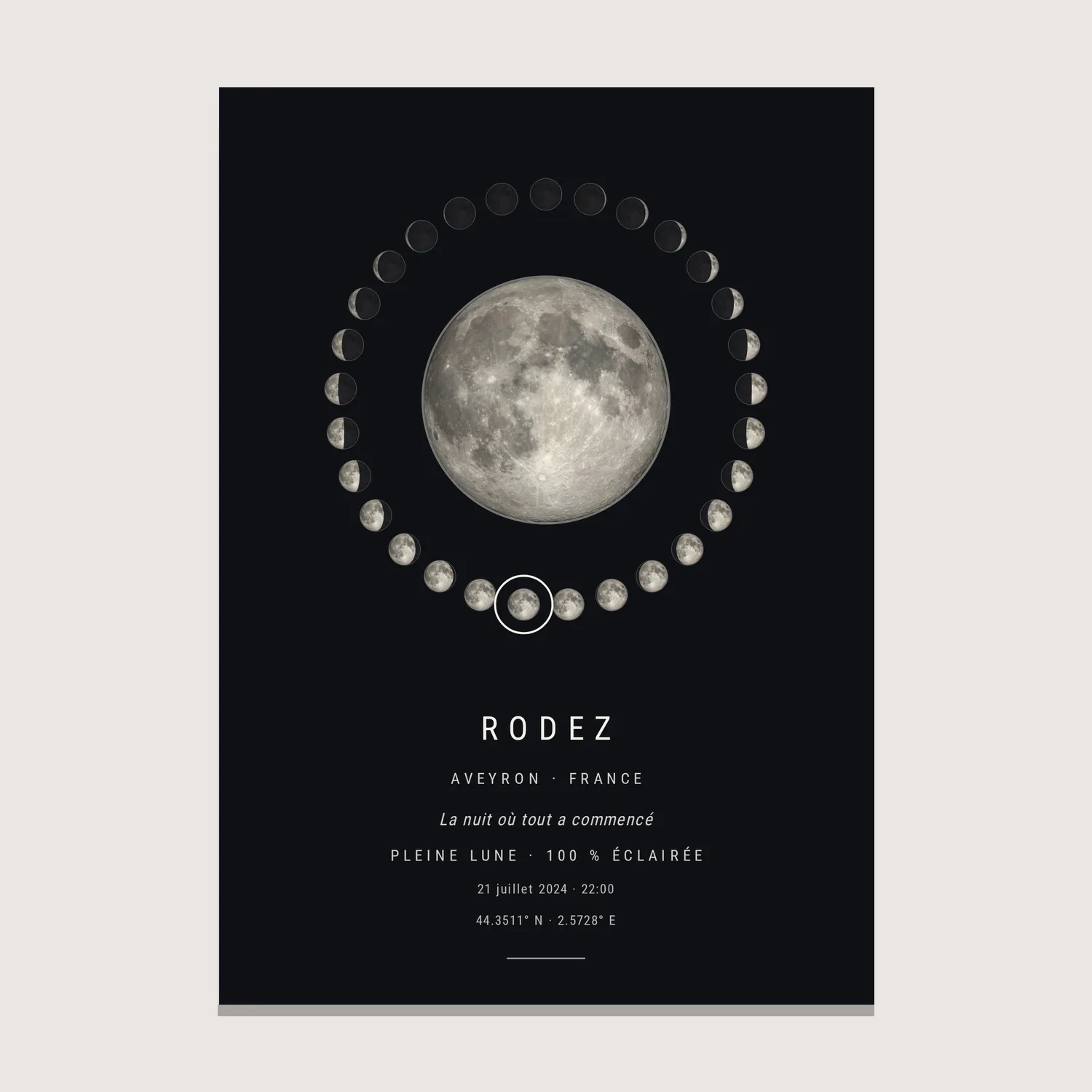
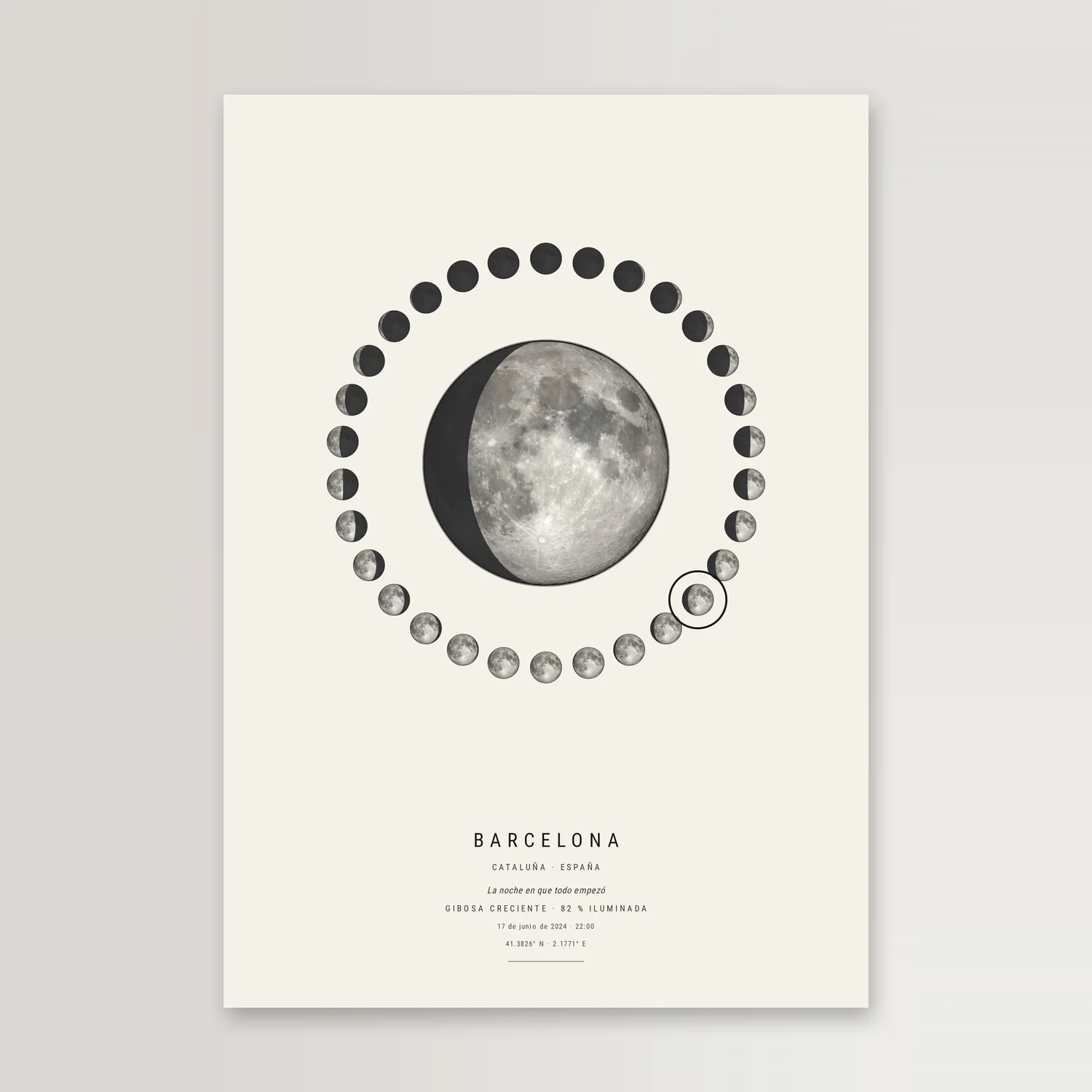
A lunation is the time between two new moons: 29.53 days on average, so 29 or 30 nights depending on the month. The poster shows the moon of the chosen night at the centre and, in a ring around it, every night of that lunation, each at its own lighting, yours marked. You can tell at a glance whether the evening fell early in the cycle, in the middle or near the end.
One detail that matters when you pick the date: twelve lunations make 354 days, eleven fewer than a year. So the moon on an anniversary is almost never the one from the original day, and the poster carries the moon of the night itself, not of the evening you celebrate.
That moon is a NASA render built from a probe’s data, not a photograph, tinted to the chosen style and lit according to the calculated phase. In the southern hemisphere it appears mirrored, which is why the city is asked for: the poster draws it as it was seen from there.
For which occasions can you give the moon of a date?
For anything that has a date: a birth, a first meeting, a wedding, a birthday, a Christmas. What changes from one occasion to the next is what you write around the moon: a title of 24 characters at most, and an optional dedication of 40 at most, both of which you see before ordering.
- A birth: the first name as the title, the city and the time on the birth record. It’s the night that will never come again.
- A first meeting: “The night it all began” as the dedication, and the city of that evening, not the one you live in now.
- A wedding: both first names as the title, and “That night, we said yes” as the dedication.
- A birthday: the moon of the day someone was born, forty or fifty years on.
- Christmas: the moon of a date that matters to that person and not to everyone: a first Christmas as a couple, a move, a promotion.
How long do you have to order for Christmas?
By 18 December for delivery in France, by 14 December for Christmas Eve in Germany, by 27 December for the Three Kings in Spain, and by 15 December for every other EU country, Ireland included: the table below gives each date. They keep two or three days of slack on the real timing, which is four to five days in France and six to seven elsewhere in Europe, printing included.
And if the deadline has passed? There is still the printable file: ten files, five sizes as PDF and PNG, available through a link the same day, which any photo print shop can print. You lose the wooden frame, not the moon.
| Country | When presents are opened | Order by |
|---|---|---|
| France | under the tree, on 25 December | 18 December |
| Germany | Bescherung, on the evening of the 24th | 14 December |
| Spain | the Three Kings, on 6 January | 27 December |
| Other EU countries, including Ireland | on 25 December | 15 December |
| Printable file | no workshop delay | a link the same day |
Which size, which style, which frame?
Ten styles, from midnight blue to pale paper, and five sizes, from A4 to 70 × 100 cm. To choose, look at the wall: a dark style stands out on a light wall, a light one melts into a wooden room. A4 and 30 × 40 can be ordered with a wooden frame, in black, white or natural; the bigger sizes are sent rolled, ready for a standard frame at home.
One limit worth knowing: the moon image is enlarged on the biggest sizes. At 70 × 100 it is best seen from a distance rather than up close; for a gift that gets opened and held in the hands, 30 × 40 or 40 × 60 are the most comfortable.
And for a couple, the moon of each birth?
If the date that matters isn’t one night but two, the day each of you was born, another poster puts the moon of each birth side by side, with a third, smaller one for the night you met. The first is the moon of one night and its whole month; the second is the moon of two lives coming together.
Frequently asked questions
What was the moon phase on the day I was born?
It is worked out from your date of birth, an approximate time and the city. In the poster editor, that night’s moon appears as soon as you enter the three, with the name of its phase and the share lit, without ordering anything: the preview is the print.
What is a lunation?
It is the time between two new moons: 29.53 days on average, so 29 or 30 nights. The poster shows all of them in a ring around the moon of the chosen night, each at its own lighting, yours marked.
Can I give the moon of a wedding, a first meeting or a birth?
Yes: any past or future date works, you only need a date, an approximate time and a city. A title of 24 characters at most and an optional dedication of 40 at most go with it, and you see them before ordering.
How long do I have to order for Christmas?
For a printed poster: by 18 December for France, by 14 December for Christmas Eve in Germany, by 27 December for the Three Kings in Spain, by 15 December for the other EU countries. After those dates, the printable file can be downloaded the same day.
Does the place change the moon?
A little: it gives the local time, daylight saving included, and the direction of the moon, which appears mirrored in the southern hemisphere. The poster draws it as it was seen from there.
Do I need to know the exact time?
No: an approximate time almost always does, since the moon changes little in an hour. The field is required, but “around 10 pm” is fine. Only a phase that changes name during the day can come out differently, and the preview shows you.
Is the moon on the poster a photograph?
No, it is a NASA render built from a probe’s data: the real moon, tinted to the chosen style, lit according to the calculated phase and mirrored in the southern hemisphere. On the biggest sizes the image is enlarged.
Which sizes, which frame, how long does it take?
Five sizes, from A4 to 70 × 100 cm. Only A4 and 30 × 40 can be ordered with a wooden frame (black, white or natural); the others arrive rolled. Printing takes 48 hours, then delivery to a pickup point or your door; the two biggest sizes go to your door only.